Skip to content

AI knowledge assistant for government, on your own infrastructure

DocsGPT is an internal knowledge assistant for government teams that runs on government infrastructure with local inference, answers from approved documents with citations, and restricts what each user can retrieve. No data leaves the network. The UK Department for Work and Pensions deployed an internal knowledge assistant of this kind on government infrastructure, with local inference.

Last updated:

Knowledge retrieval pipeline
  1. 01Approved sourcespolicy · guidance · legislation
  2. 02Ingestion & embeddings30+ formats · local embeddings
  3. 03Permission-scoped retrievalteam-shared sources only
  4. 04Cited answerlocal LLM · title + page
  5. 05 · humanFeedback & audit logconversation + audit export
Text version

Five stages: approved policy, guidance and legislation are ingested and embedded locally; retrieval is limited to sources the user's team may see; a locally served model writes an answer with title and page citations; staff feedback and every exchange land in the audit log the department exports to its own monitoring.

The situation

  • Compliance

    Compliance rules are strict and differ by department: many require no external API calls and fully on-premises processing; all require every processing location to be declared before the service goes live.

  • Classification

    Documents sit at several classification levels, so access has to be enforced when a document is retrieved for an answer, not only in the interface that shows it.

  • Scale

    A departmental assistant must be available to a large workforce, at scale and around the clock, on infrastructure the department already operates.

What DocsGPT does here

Workflow 01

Internal knowledge assistant over policy and guidance

Ingestion of 30+ formats and a SharePoint connector bring policy, guidance and legislation into one knowledge base. Hybrid retrieval (BM25 + vector) finds the passage; the answer cites title and page so a caseworker can open the source.

30+ formats · SharePoint connector · hybrid retrieval · citations (title, page)
Search & Retrieval →Knowledge & Connectors →

Workflow 02

Access control that follows the user into retrieval

Teams and workspaces scope which sources an agent may search; users sign in through the department's IdP with OIDC and group allowlists; SCIM deprovisioning revokes sessions immediately; roles limit what each person can administer. An assistant retrieves only from sources shared to its user's team.

Teams & workspaces · OIDC SSO with group allowlists · SCIM · RBAC

Built for the client · query-level access enforcement across several classification levels, for the DWP.

Admin, Security & Analytics →

Workflow 03

Local inference, no data leaves the network

Models are served inside the department with vLLM, Ollama or llama.cpp; embeddings are computed locally; the vector store is self-hosted. Kubernetes manifests deploy the stack, and OpenTelemetry exports traces and metrics to the department's monitoring.

vLLM · Ollama · llama.cpp · local embeddings · Kubernetes manifests · OpenTelemetry

Models & BYOM →On-premises deployment →

Workflow 04

Governance: approved sources only, everything recorded

Guardrails check for PII, banned terms and prompt injection on the way in and out. The audit table exports to the department's SIEM; conversation logs and analytics show who asked what, which sources were used and what it cost.

Guardrails (PII, banned terms, prompt injection) · audit export to SIEM · conversation logs · analytics

Guardrails & Human-in-the-loop →Admin, Security & Analytics →

Procurement posture: how DocsGPT and Arc53 answer the requirements that recur in UK public-sector tenders.

Procurement posture against recurring UK public-sector requirements
 PositionHow it is met
WCAG 2.2 AAAudit and remediation committed within a first projectIndependent WCAG 2.2 AA audit and full A/AA remediation scoped into the project; the report is delivered to the department
DPIA support and data-flow documentationProvidedArc53 supplies the data-flow description and supports the department's DPIA before deployment
No training of foundation models on client dataNativeSelf-hosted models see no third party; where a cloud endpoint is chosen, the provider is contracted not to train on the data
UK hosting or on-premisesBothOn the department's own infrastructure, or a UK single-tenant managed instance in a declared region
Exit planProvidedOpen-format export of documents, agents (YAML) and logs; documented decommissioning; MIT-licensed code the department may keep running
CertificationsPosture plus programmeNo certification held today. Security programme: GitHub Secure Open Source Fund, public threat model, SBOM, CodeQL, coordinated disclosure — see Security

Statuses as of 2026-09-11.

docsgpt — chat

app · Admin › Audit
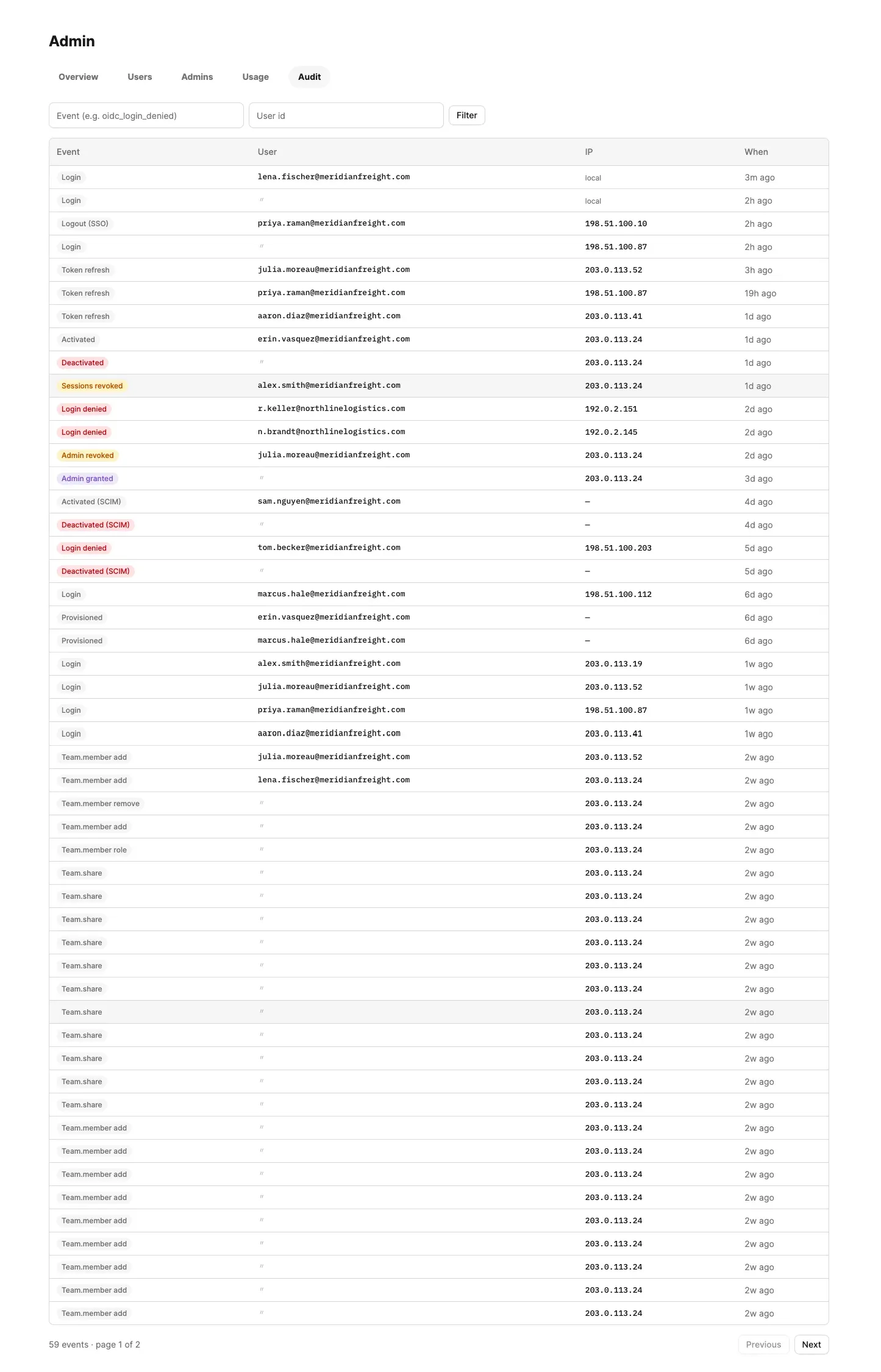
Admin › Audit: 59 events filterable by event name (for example oidc_login_denied) and by user id, in a table of Event, User, IP and When. The events include Login, Logout (SSO), Token refresh, Activated and Deactivated, Sessions revoked, Login denied, Admin granted and Admin revoked, Activated (SCIM) and Deactivated (SCIM), Provisioned, and team events — Team.member add, Team.member remove, Team.member role and Team.share.
app · Admin › Audit
Admin › Audit: 59 events filterable by event name (for example oidc_login_denied) and by user id, in a table of Event, User, IP and When. The events include Login, Logout (SSO), Token refresh, Activated and Deactivated, Sessions revoked, Login denied, Admin granted and Admin revoked, Activated (SCIM) and Deactivated (SCIM), Provisioned, and team events — Team.member add, Team.member remove, Team.member role and Team.share.

Evidence

Results from named deployments, with the source.

Government infrastructure, local inference

UK Department for Work and Pensions: an internal knowledge assistant on government infrastructure, with local inference.

Source: DWP

How it is deployed

On-premises is the usual posture here: strict data residency.

Departments run DocsGPT on their own Kubernetes or servers with a local model — the posture the DWP deployment uses. Where a department accepts it, a UK single-tenant managed instance is the second option, with Arc53 operating the instance in a declared region. Cloud endpoints, where chosen, are contracted no-training, and every sub-processor and its region is published in the DPA.

What a first project looks like

Scope, measure, then decide.

  1. 01

    Scope one team and one corpus

    Policy or guidance for a single team; the document owners write 20–30 test questions with the expected answers and sources.

  2. 02

    DPIA support and data-flow documentation

    Arc53 provides the data-flow description and supports the department's DPIA before anything is deployed.

  3. 03

    Deploy on the department's infrastructure

    Or a UK single-tenant managed instance; SSO through the department IdP; a locally served model.

  4. 04

    Ingest and benchmark

    Run the test set against the assistant and iterate until source assertions pass.

    docsgpt-cli bench

  5. 05

    Pilot for about three months

    Measure citation click-through and answer acceptance with the team.

  6. 06

    Decision on rollout

    With the pilot's evidence, the department decides scope and posture for wider use.

The DWP deployment began with a scoped first project of this shape on government infrastructure with local inference. See pricing for how on-premises and managed work is priced.

Frequently asked questions

Can a government department use AI on internal documents without sending data outside?

Yes. DocsGPT runs on the department's own Kubernetes or servers with a local model and local embeddings; nothing is sent to a third party. That is how the DWP deployment is set up.

Is our data used to train the model?

No. With self-hosted models there is no third party to train on it; where a department chooses a cloud model, Arc53 engages that provider only on terms that prohibit training, and publishes every sub-processor and its region in Annex III of the DPA. Providers may hold a request for up to 30 days for their own abuse monitoring; removing that is an Enterprise add-on.

How is access to classified documents controlled?

Users sign in with the department's IdP (OIDC), sources are shared to teams, and an assistant only retrieves from sources shared to its user's team. Provisioning and removal follow the IdP through SCIM.

Which security certifications does DocsGPT hold?

None today. The evidence for a security questionnaire is the deployment posture plus an active security programme: GitHub Secure Open Source Fund participation, a public threat model, SBOM, CodeQL and coordinated disclosure. Current status is on Security.

Is the application accessible (WCAG 2.2 AA)?

An independent WCAG 2.2 AA audit and full A/AA remediation are included in a first project; the report is delivered to the department.

See DocsGPT on your documents

A 30-minute demo on your use case, or a free on-premises review with an engineer.