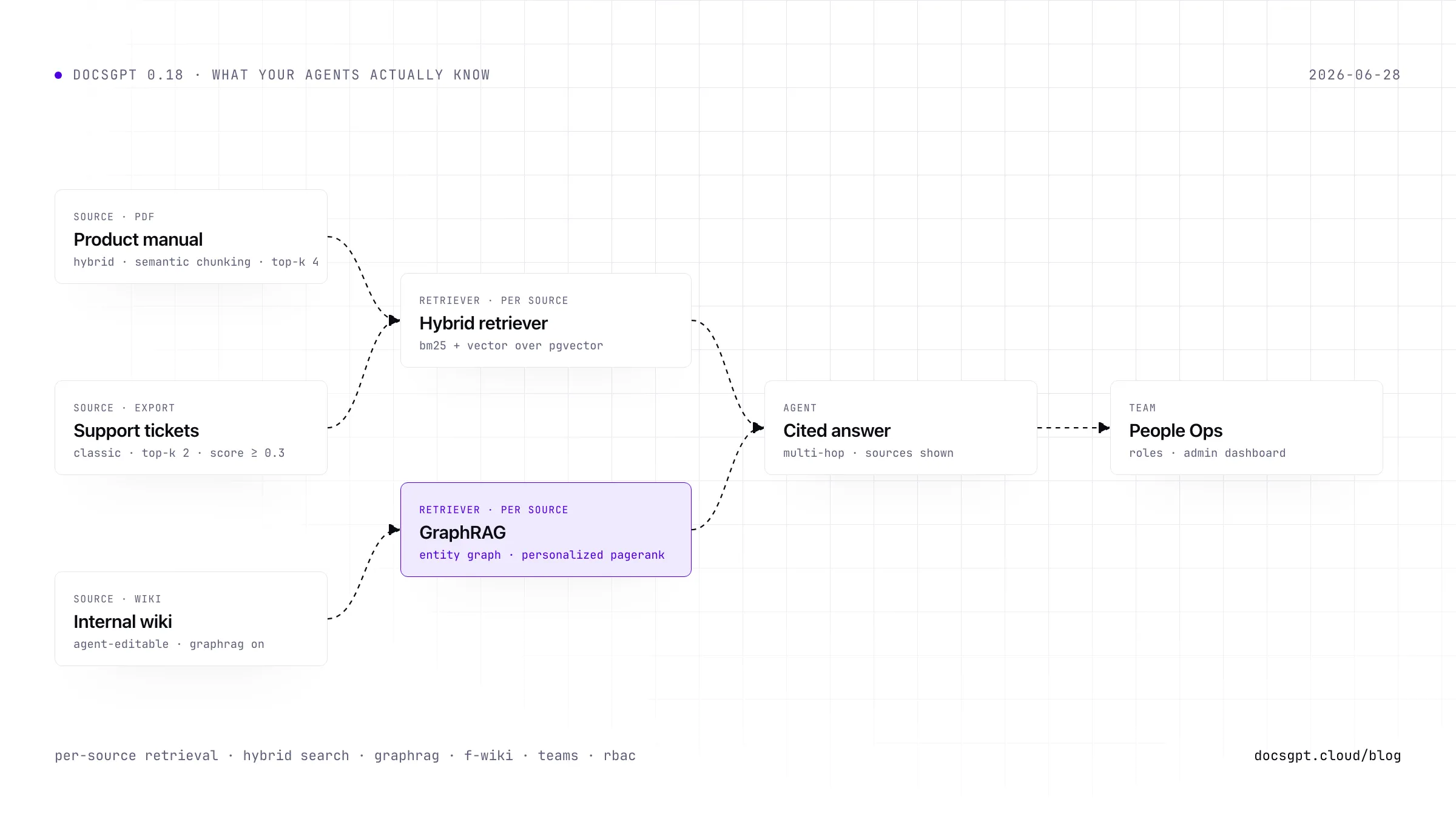
We spent the last cycle teaching agents to act on their own: scheduled runs, SSO, an audit trail for everything they did while you slept. An agent acting on its own is only as good as what it can find, and classic chunk-and-embed retrieval has been the weak link for a while. 0.18 rebuilds that layer. Your sources can now be tuned individually, queried over a knowledge graph, and even rewritten by the agents that read them. And because none of that is useful alone, this release also adds the teams and roles to run it with other people.
Retrieval You Can Tune Per Source
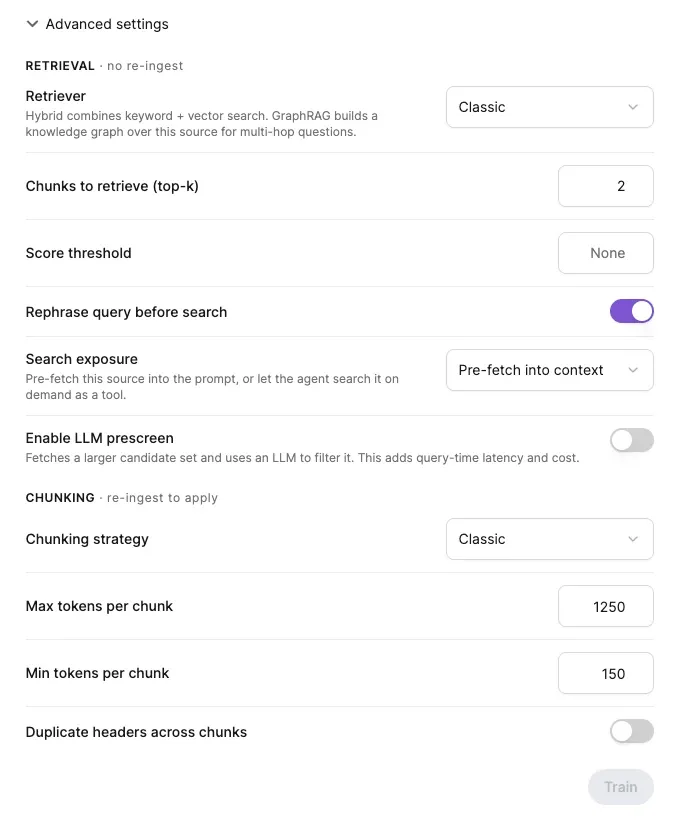
Every source used to share one retrieval pipeline. Now each one carries its own configuration: the retrieval strategy, how it gets chunked, and how much of it an agent is allowed to see. A polished product manual and a dump of raw support tickets do not want the same settings, and now they don’t have to share them.
The new default-quality path is a hybrid retriever that runs BM25 keyword search and vector similarity together over pgvector, so exact-match terms like error codes and SKUs survive alongside semantic recall. Pair it with semantic chunking, which splits documents on meaning instead of a fixed token count, and retrieval stops slicing sentences in half at the 512-token mark.
Why it matters: retrieval quality is mostly a per-source problem, and treating a legal PDF the same as a Slack export was always going to leak relevance somewhere.
GraphRAG: Answers That Need More Than One Hop
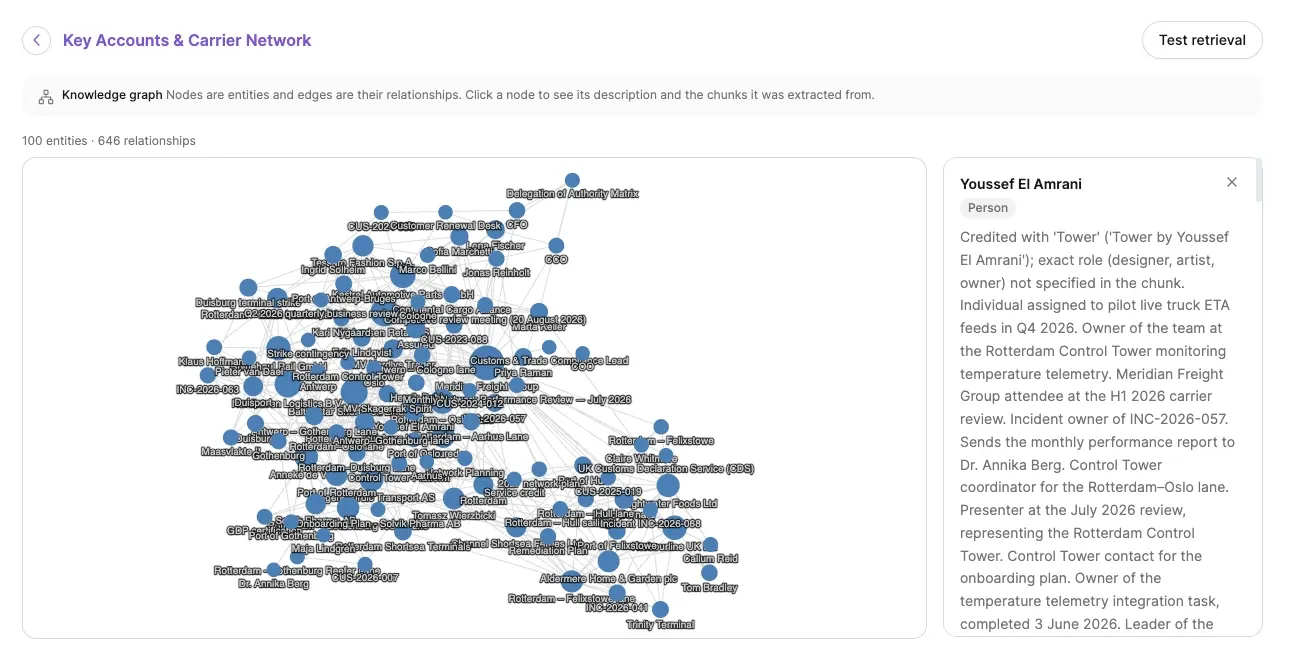
Vector search is good at “find me the paragraph that looks like this question.” It falls apart on questions whose answer is spread across documents that never mention each other. 0.18 adds a GraphRAG retriever that builds a per-source knowledge graph at ingest time, extracting entities and the relationships between them, then retrieves over that graph using Personalized PageRank to walk from the parts of the graph your query touches out to the connected facts that matter.
Enabling it is a per-source action with live progress streaming while the graph builds, and you can rebuild it as the source changes. There’s also a graph view so you can see the entities and edges the retriever is actually reasoning over instead of trusting a black box.
Why it matters: “which customers are affected by the bug in the auth service that Priya flagged” is three hops across three documents. That’s the query class classic RAG quietly gets wrong.
A Wiki Your Agents Keep Current
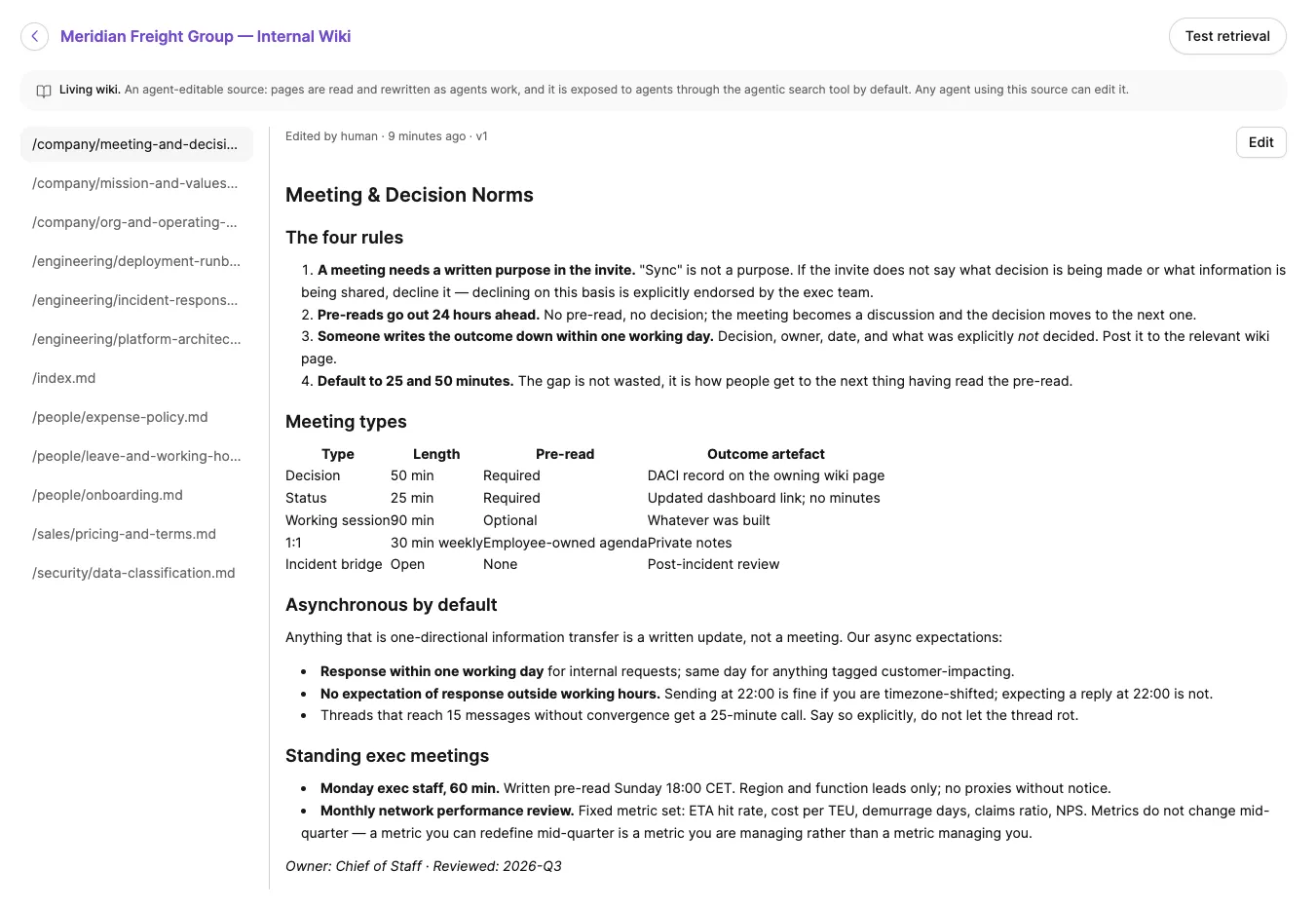
Most knowledge bases rot because keeping them current is a chore nobody owns. F-Wiki is a new source type that agents can edit. An agent with write access can correct a stale page, add a section, or reconcile two conflicting docs as it works, and every machine edit lands with a provenance stamp so you can see what changed and who, or what, changed it. Humans edit pages too, in the same place.
You can convert an existing source into a wiki, and DocsGPT reassembles its pages from the chunks you already ingested, so you’re not starting from a blank page. The result is a knowledge base that drifts toward correct instead of away from it.
Why it matters: documentation that updates itself is the difference between a knowledge base and a graveyard.
Teams, Roles, and an Admin View
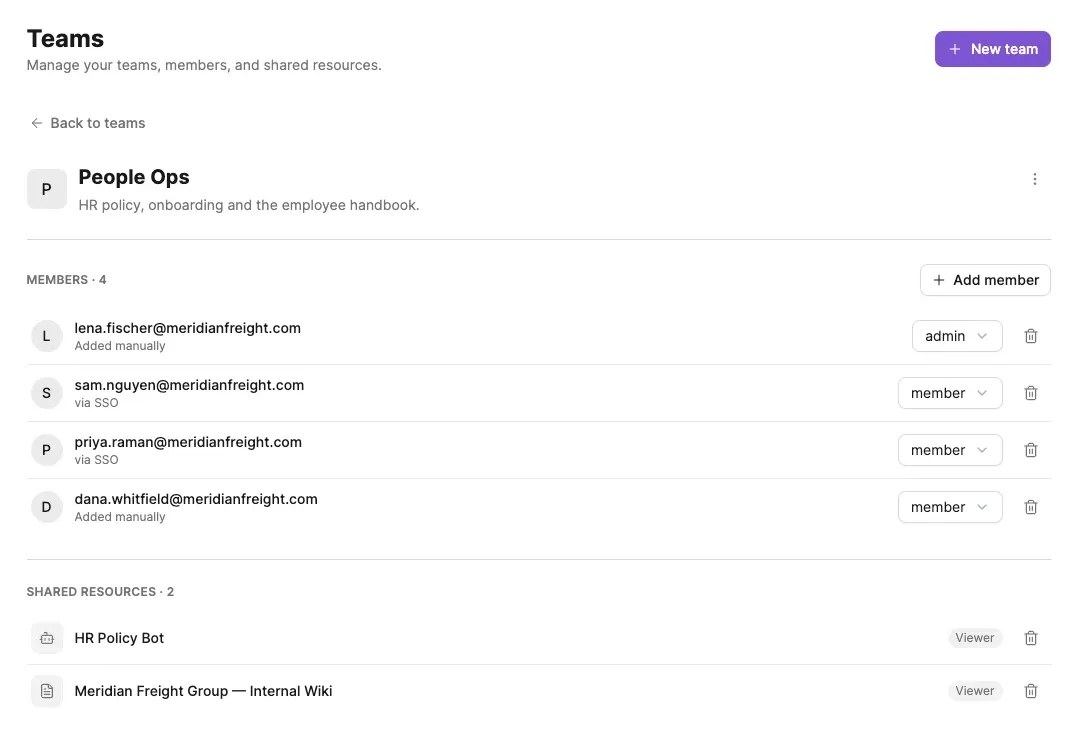
A self-updating knowledge base that one person controls isn’t worth much. 0.18 makes DocsGPT multi-person. Teams group people and the sources, agents, and conversations they share. Role-based access control gives admins a real permission model instead of all-or-nothing access, and a new admin dashboard puts usage and management in one place.
Moving work between instances and people got easier too: agent import/export lets you package an agent and its configuration as a file, then drop it into another workspace, share it with a teammate, or check it into version control.
Why it matters: the features above only pay off when a whole team can use them without stepping on each other.
Also In This Release
The autonomy stack from our 3 A.M. post shipped in full here too, alongside a deeper plumbing pass:
- Agent scheduling on a cron or one-off basis, backed by RedBeat
- Enterprise OIDC login with groups, renewal, logout, and SCIM provisioning
- Rebuilt analytics and a unified logs timeline on Postgres
- OpenAI-compatible
/v1/chat/completionswith structured outputs, multimodal input, and stateless tool continuation - Bring Your Own Model, plus DeepSeek and an OpenAI Responses API flavor
- In-app notifications, conversation search, and a remote-device tool
- An ASGI rewrite, durability and idempotency keys, and OpenTelemetry instrumentation
Give It Something Worth Knowing
Point an agent at a messy pile of sources, turn on GraphRAG, let it keep the wiki current, and share the whole thing with your team. The knowledge layer finally keeps up with the agents working on top of it.
- Try DocsGPT Cloud
- Explore the Repository
- Join our Community on Discord, X and LinkedIn